
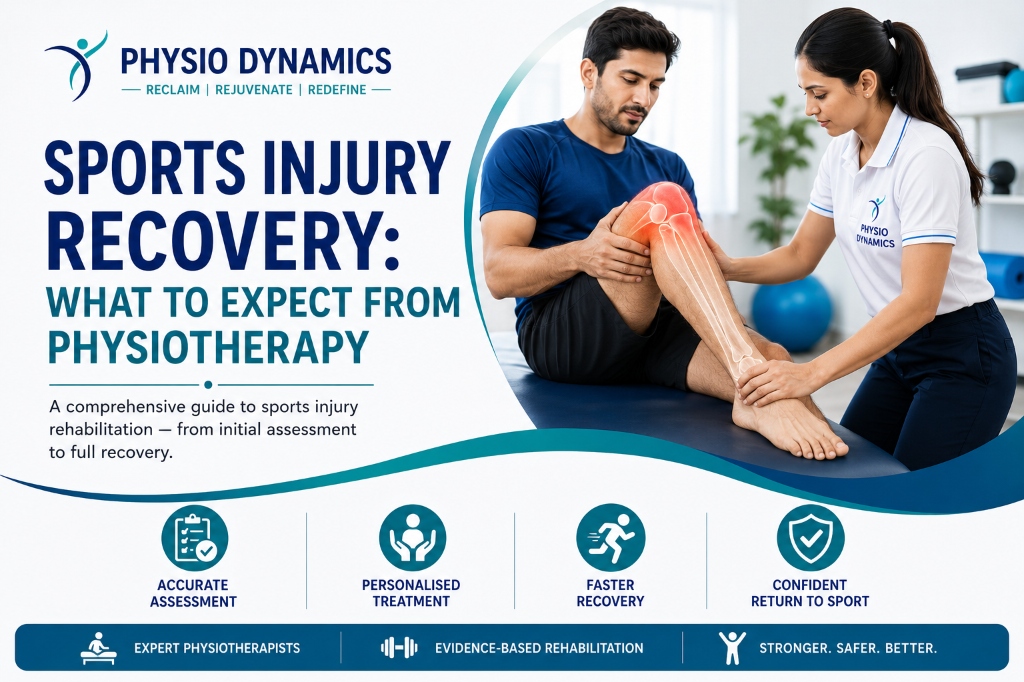
Every runner has experienced knee discomfort at some point. When knee pain develops, the immediate question is always: *Should I stop running completely, or is it safe to keep running?*
The answer is not a simple yes or no. Complete rest can cause your thigh muscles to weaken and joints to stiffen, which can actually worsen knee pain long-term. On the other hand, running through sharp pain can damage joint structures like the meniscus or ligaments.
At **Physio Dynamics** in Panamaram, Wayanad, chief physiotherapist **Dr. Sandra Thomas (PT)** helps runners assess their joint loading parameters so they can modify their running form and recover safely.
The Limping Check: If knee pain changes your running style or causes a limp, stop running immediately. Running with altered form places loaded, unbalanced stress on your opposite hip and ankle.
The Golden Rules of Running with Discomfort
Use these clinical benchmarks to evaluate if it is safe to run:
Pain Level Under 3 out of 10
On a scale of 0 (no pain) to 10 (emergency pain), any discomfort during your run must stay under a 3. If pain is a mild, diffuse ache that fades as your joint warms up, it is generally safe to continue running at a modified pace.
Zero Pain Post-Run or the Next Morning
Your knee joint should feel completely normal within 24 hours of your run. If your knee aches, throbs, or feels stiff the next morning, it is a sign that the running load exceeded your joint's current healing capacity.
No Swelling or Limping
If your knee swells up after a run, or if the pain forces you to limp or shorten your stride, stop running immediately. These signs indicate active tissue inflammation or structural irritation.
Safe vs. Dangerous Knee Pain
| Safe Discomfort (Modify Load) | Dangerous Pain (Stop & Consult) |
|---|---|
| Diffuse ache around the kneecap that fades as you warm up | Sharp, pinpoint pain on the inside or outside of the knee |
| Mild stiffness in the morning that disappears quickly | Knee locking, clicking loudly, or "giving way" under weight |
| Pain disappears within 24 hours of your workout | Severe swelling, heat, or throbbing pain post-run |
How to Modify Your Running Load
If your pain is in the "safe" zone, you can continue running by making these adjustments:
- Increase Cadence: Take shorter, faster steps (aim for 170-180 steps per minute). This reduces joint loading forces by up to 20%.
- Avoid Downhill Running: Running downhill increases knee impact forces significantly. Stick to flat tracks or run uphill.
- Change Running Shoes: If you have kneecap friction pain (Runner's Knee), temporarily switch to shoes with a higher heel-to-toe drop (10-12 mm) to offload the knee.
Running Rehabilitation in Panamaram, Wayanad
At **Physio Dynamics**, we evaluate your running gait to find the root cause of joint stress. We provide:
Frequently Asked Questions
Run Pain-Free and Protect Your Joints
Do not let knee pain sideline you. Book a running movement screen with our physical therapists today.