
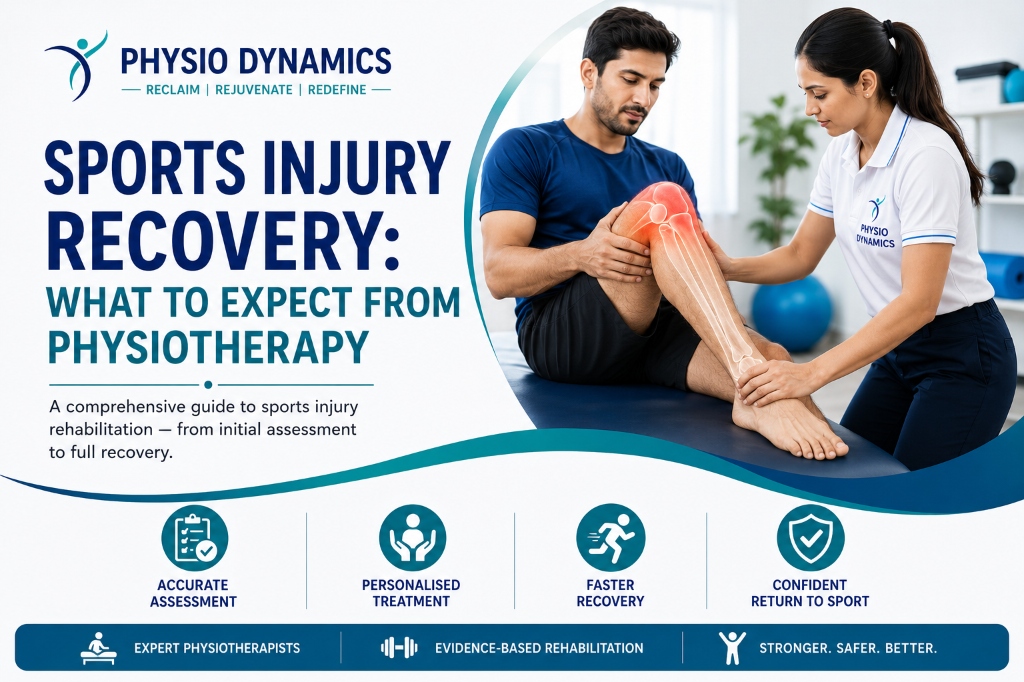
A calf muscle tear (often referred to in sports medicine as **Tennis Leg**) is a painful injury common in middle-aged runners, badminton players, and footballers. It typically occurs when you sprint, jump, or pivot suddenly.
Athletes often report feeling a sudden, sharp snap in the back of the lower leg, as if they were kicked or struck by a ball. This is followed immediately by severe pain, difficulty walking, and swelling.
At **Physio Dynamics** in Panamaram, Wayanad, chief physiotherapist **Dr. Sandra Thomas (PT)** provides specialized calf tear rehabilitation. We guide patients from early walking offloads to progressive strength recovery.
Use a Heel Lift: Walking with a limp stretches the torn calf fibers. Inserting a temporary 1-2 cm heel lift in both shoes offloads tension, allowing you to walk pain-free during early healing.
Grading Calf Muscle Tears
Calf strains affect either the large outer muscle (Gastrocnemius) or the deeper soleus muscle:
- Grade 1 (Mild Strain): Micro-tears in less than 5% of muscle fibers. You experience mild tightness but can walk.
- Grade 2 (Partial Tear): Significant tearing of muscle fibers. You experience sharp pain, swelling, and deep bruising, making walking very painful.
- Grade 3 (Complete Rupture): A complete tear of the muscle belly. You experience immediate severe pain, significant swelling, and an inability to stand on your toes.
3 Recovery Exercises for Calf Rehabilitation
Once walking is pain-free without a limp, we introduce progressive loading exercises:
Double-Leg Calf Raises (Flat Ground)
Stand with feet hip-width apart. Slowly raise up onto the balls of your feet, hold for 2 seconds, then lower down slowly (taking 3 seconds). Complete 3 sets of 15 repetitions. This builds initial calf muscle tissue capacity.
Single-Leg Calf Raises
Stand on one foot (using a wall for balance). Slowly push up onto your toes, hold for 2 seconds, and lower down. Complete 3 sets of 12 repetitions on the injured leg. Rebuilding single-leg strength is essential before returning to running.
Soleus Seated Calf Raises
Sit on a chair with your knees bent at 90 degrees and feet flat on the floor. Place a heavy weight (like a dumbbell or water bottle) on your thighs. Slowly raise your heels off the floor, hold for 2 seconds, then lower. Complete 3 sets of 15 repetitions. Bending the knee isolates the Soleus muscle.
Calf Care at Physio Dynamics
At **Physio Dynamics** (Panamaram, Wayanad), we prioritize safe recovery and reinjury prevention. We provide:
Frequently Asked Questions
Walk and Run Pain-Free Again
Do not let a calf strain turn into a chronic tear. Schedule your assessment or book a home care visit today.