
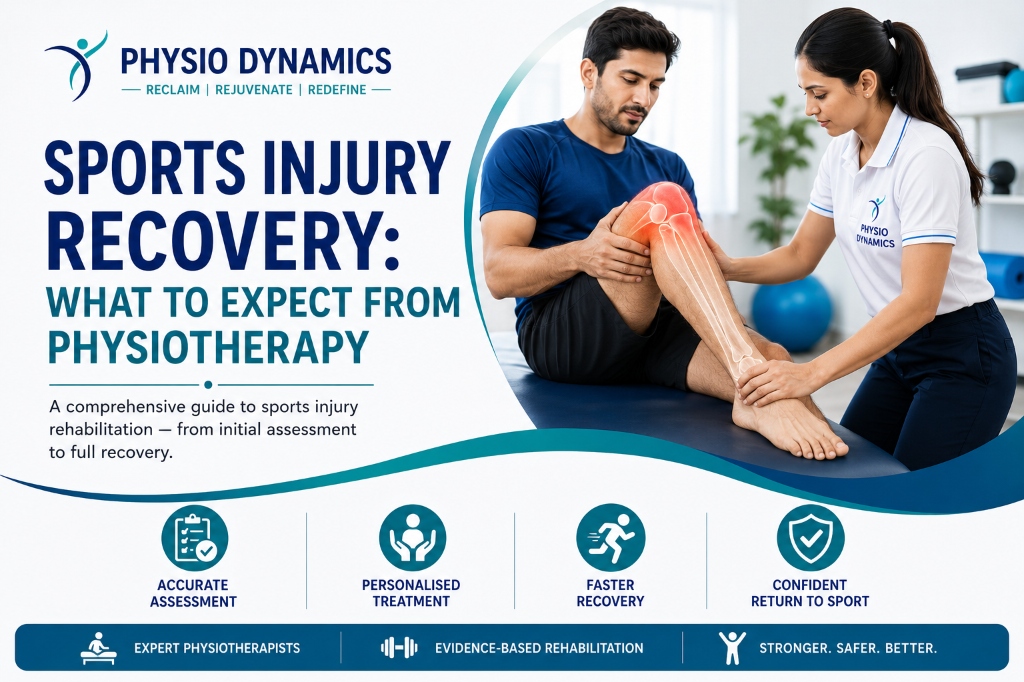
Recovering from a major sports injury, like an ACL tear, meniscus damage, or severe shoulder dislocation, is a long journey. Many athletes believe that once their pain is gone and their doctor says the tissue has healed, they can immediately jump back into a match.
This assumption is one of the leading causes of reinjury. Returning to play before your body has adapted to high-velocity force, pivoting, and sudden cutting maneuvers is high-risk. **Return-to-Sport (RTS) Rehabilitation** is a structured, criteria-based protocol designed to bridge the gap between basic mobility and game performance.
At **Physio Dynamics** in Panamaram, Wayanad, chief physiotherapist **Dr. Sandra Thomas (PT)** utilizes objective movement screening and criteria-based progression to ensure local athletes return to playing safely.
Timeline vs. Criteria: Never base your return to play on a calendar timeline alone. You are only ready when your injured limb meets objective strength and balance symmetry benchmarks compared to your healthy limb.
What Is Return-to-Sport Rehabilitation?
RTS rehabilitation is the final phase of sports physical therapy. It transitions an athlete from general strength recovery to sport-specific coordination drills. Instead of focusing only on joint flexibility, RTS training focuses on:
- Rate of Force Development: Building explosive power required for sprinting or jumping.
- Neuromuscular Control: Restoring automated joint stabilization reflexes during sudden, unexpected shifts in balance.
- Sport-Specific Mechanics: Re-educating movement patterns like kicking a football, serving a badminton shuttle, or bowling a cricket ball.
- Psychological Confidence: Rebuilding trust in the injured joint to prevent hesitant movements that cause compensations.
The 3 Phases of RTS Progression
The transition back to competitive play follows three strict phases:
Return to Participation
The athlete is pain-free during daily tasks and can perform low-impact training (like light jogging or swimming) but is restricted from contact practice or high-velocity pivoting.
Return to Sport
The athlete resumes team training sessions under modified conditions. They can participate in passing drills or skill work but avoid full-contact match play or competitive scrimmages.
Return to Performance
The athlete is cleared for full competitive match play. Their performance, confidence, and limb symmetry match or exceed their pre-injury status.
Essential RTS Testing Benchmarks
To pass Phase 3 and return to performance, athletes must meet the following criteria:
- Limb Strength Symmetry: The injured leg must have at least 90-95% of the quadriceps and hamstring strength of the healthy leg.
- Y-Balance Test: Demonstrates stable lateral balance control during reaching.
- Hop Tests: Measures equal single-leg hop distance, triple hop, and crossover hop symmetry.
- Biomechanical Form: Zero hip collapse or knee valgus (knee caving inward) during landing drills.
RTS Testing in Panamaram, Wayanad
At **Physio Dynamics**, we use structured athletic testing to clear players for competition. We offer:
Frequently Asked Questions
Get Cleared for Competition Safely
Ensure your body is fully ready for the demands of match play. Book an RTS assessment with our sports therapists today.