
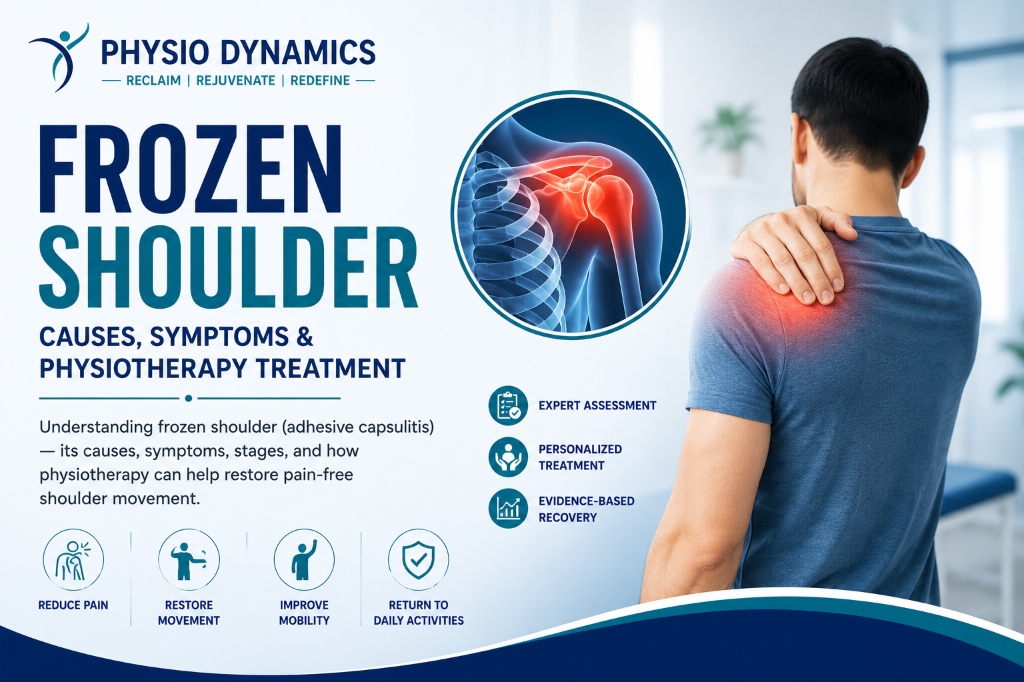
If you're struggling to lift your arm, reach behind your back, or perform simple daily activities due to shoulder pain and stiffness, you may be experiencing frozen shoulder, also known as adhesive capsulitis.
Frozen shoulder develops gradually and can significantly affect your quality of life if left untreated. Fortunately, physiotherapy is one of the most effective treatments for reducing pain, restoring mobility, and helping you return to normal activities.
In this guide, we'll explain the causes, symptoms, stages, and treatment options for frozen shoulder.
Note: Early diagnosis and physiotherapy can help improve recovery and reduce long-term stiffness.
What Is Frozen Shoulder?
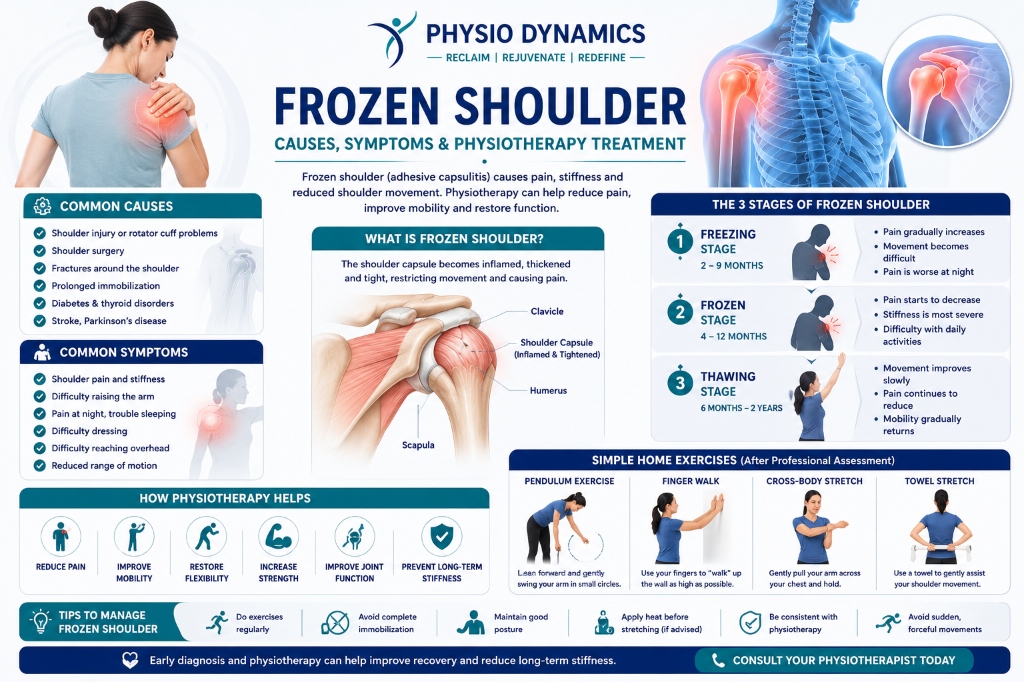
Frozen shoulder is a condition in which the capsule surrounding the shoulder joint becomes inflamed, thickened, and tight. This restricts shoulder movement and causes persistent pain and stiffness.
The condition usually develops slowly over several months and progresses through different stages before improving.
Who Is at Risk?
Frozen shoulder is more common in:
- Adults between 40 and 60 years of age
- People with diabetes
- Individuals recovering from shoulder surgery
- People whose shoulder has been immobilized after an injury
- Individuals with thyroid disorders
- Women (slightly more common than men)
Although it often affects one shoulder, it can occasionally occur in both.
Common Causes of Frozen Shoulder
The exact cause of adhesive capsulitis is not always known, but contributing factors include:
Symptoms of Frozen Shoulder
Symptoms usually worsen gradually and may include:
- Persistent shoulder pain
- Increasing stiffness
- Difficulty raising the arm
- Pain while sleeping on the affected side
- Difficulty dressing
- Difficulty reaching overhead
- Trouble fastening clothing behind the back
- Reduced range of motion
Daily activities like combing hair or reaching for objects on a shelf often become difficult.
The Three Stages of Frozen Shoulder
Frozen shoulder typically progresses through three distinct clinical phases, each with varying symptoms and duration:
| Stage | Duration | Description |
|---|---|---|
| Stage 1 – Freezing Stage | 2 to 9 Months | Shoulder pain gradually increases, movement becomes increasingly difficult, and pain is often worse at night. |
| Stage 2 – Frozen Stage | 4 to 12 Months | Pain may begin to decrease, but stiffness becomes more severe. People often notice difficulty performing routine activities. |
| Stage 3 – Thawing Stage | 6 Months to 2 Years | Movement slowly improves, pain continues to reduce, and shoulder mobility gradually returns. Recovery may take 6 months to 2 years, depending on the individual. |
How Physiotherapy Helps Frozen Shoulder
Physiotherapy plays a vital role throughout recovery by helping:
Treatment is always adjusted according to the stage of your condition.
Common Physiotherapy Treatments
Depending on your symptoms, clinical treatment may include:
- Manual therapy
- Gentle shoulder mobilization
- Stretching exercises
- Range-of-motion exercises
- Strengthening exercises
- Posture correction
- Home exercise program
- Pain management techniques
Your physiotherapist will gradually progress your exercises as your shoulder improves.
Frozen Shoulder Guide: Causes, Symptoms, Stages, & Exercises — recommended by Sandra Thomas, BPT, Consultant Physiotherapist, Physio Dynamics.
Simple Home Exercises
After professional assessment, you may be advised to perform exercises such as:
Pendulum Exercise
Allows the humerus head to drop out of the socket slightly to relieve joint pressure and stiffness gently.
How to Perform
- Lean forward, supporting your non-injured arm on a table or chair.
- Let your affected arm hang vertically downward.
- Gently swing the arm in small circles (clockwise and counterclockwise).
- Keep your arm muscles relaxed, using the momentum of your torso.
Finger Walk Exercise
Slowly encourages active-assisted flexion of the shoulder joint using a wall for support.
How to Perform
- Stand facing a wall, about three-quarters of an arm's length away.
- Touch the wall at waist level with the fingers of your affected hand.
- Slowly walk your fingers up the wall as high as comfortably possible.
- Hold the stretch at the top for 5 seconds, then crawl back down.
Cross-Body Stretch
Helps stretch the posterior capsule of the shoulder joint, which is commonly tight in frozen shoulder.
How to Perform
- Stand or sit comfortably.
- Use your unaffected arm to pull the affected arm gently across your chest.
- Hold the stretch at a comfortable point for 20 to 30 seconds.
- Slowly return to the starting position and relax.
Towel Stretch
Stretches the joint capsule in internal rotation, assisting the affected shoulder through its available range.
How to Perform
- Hold a small towel behind your back with your unaffected arm at the top.
- Hold the other end of the towel with your affected arm at the bottom.
- Gently pull the towel upward with your top arm, stretching the affected bottom arm.
- Hold the stretch for 15–20 seconds, then slowly relax.
Important: Exercises should be comfortable and should not significantly increase your pain. Always follow the guidance of your physiotherapist.
Tips to Manage Frozen Shoulder
You can support your recovery by:
- Performing prescribed exercises regularly
- Avoiding complete shoulder immobilization
- Maintaining good posture
- Applying heat before stretching (if recommended)
- Staying consistent with physiotherapy sessions
- Avoiding sudden, forceful shoulder movements
Consistency is key to regaining movement.
When Should You See a Physiotherapist?
While home exercises are helpful, professional assessment is crucial to ensure safe recovery.
Seek Physiotherapy Advice If:
- Shoulder pain persists for more than two weeks
- Increasing stiffness or restriction in movement is noticeable
- You experience significant difficulty lifting your arm or reaching overhead
- Pain is severe at night and affects your sleep
- Your shoulder movement is reduced following a fall, injury, or surgery
- Daily tasks (like dressing, bathing, or combing hair) become difficult
Early intervention often leads to better outcomes.
Frozen Shoulder Treatment at Physio Dynamics
At Physio Dynamics Physiotherapy & Sports Rehabilitation Centre in Panamaram, Wayanad, we provide personalized treatment plans for frozen shoulder and other shoulder conditions.
Our services include:
- Comprehensive shoulder assessment to identify the stage of your condition
- Hands-on manual therapy
- Joint mobilization techniques
- Therapeutic exercise programs
- Posture and scapular alignment correction
- Dry needling (when appropriate)
- Home exercise program guidance
- Rehabilitation after shoulder surgery
- Long-term shoulder strengthening
Our goal is to reduce pain, restore mobility, and help you return to everyday activities with confidence.
Frequently Asked Questions
Common questions about frozen shoulder stages, symptoms, and physiotherapy
Book a Shoulder Assessment in Wayanad
If shoulder pain and stiffness are limiting your daily activities, let our experienced physiotherapists help you regain movement with a personalized rehabilitation program.