
Difficulty rising from a deep chair, a dull ache in your groin when walking, or sharp pain on the outside of your hip when lying down are classic signs of **hip dysfunction**. As a primary weight-bearing joint, the hip relies on a precise balance of muscle strength and joint mobility.
When the surrounding muscles (especially the gluteus medius and minimus) weaken, the hip joint experiences abnormal friction. This leads to common conditions like **hip osteoarthritis**, **trochanteric bursitis** (inflammation of the outer fluid sac), or labral irritation.
At **Physio Dynamics** in Panamaram, Wayanad, lead physiotherapist **Dr. Sandra Thomas (PT)** utilizes targeted strengthening and gentle manual distraction. This offloads the hip socket and stabilizes the pelvis for pain-free mobility.
Important Note: If your hip pain is accompanied by an inability to bear weight on the leg, or occurred after a fall, seek immediate orthopedic evaluation to rule out a hip fracture.
What Causes Hip Pain?
The most common sources of hip discomfort seen in our clinic include:
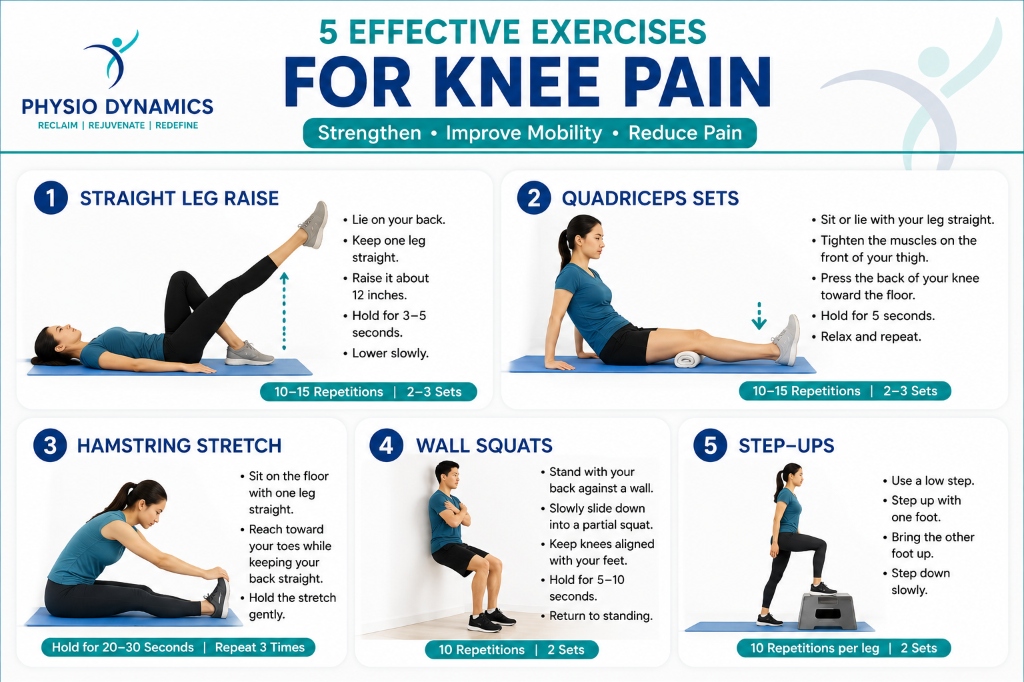
Lower Extremity Stabilization Exercises recommended by Physio Dynamics
5 Safe Exercises for Hip Pain Relief
Sidelying Clamshells
Clamshells target the gluteus medius, which controls pelvic stability. Weakness here causes the hip to drop and twist during walking, irritating the joint.
How to Perform
- Lie on your side with hips stacked, knees bent at 90 degrees, and feet together.
- Keep your heels touching and slowly raise your top knee as high as comfortable.
- Hold for 2 seconds, then slowly lower back.
Glute Bridges
Bridges strengthen the gluteus maximus and hamstrings, helping push the femoral head forward and relieving pressure on the front hip structures.
How to Perform
- Lie on your back with knees bent and feet flat on the floor, hip-width apart.
- Squeeze your glutes and push through your heels to raise your hips until your body forms a straight line from shoulders to knees.
- Hold for 2 seconds, then lower slowly.
Side-Lying Leg Raises (Abduction)
This exercise builds lateral hip strength, which is vital to prevent limping and stabilize the hip during single-leg standing.
How to Perform
- Lie on your side with your bottom leg bent for balance.
- Keep your top leg completely straight and slowly lift it up (about 45 degrees), leading with your heel.
- Hold for 2 seconds, then lower slowly. Do not roll your pelvis backward.
Standing Hip Extension
A safe, standing exercise to activate the posterior chain muscles (glutes/hamstrings) without placing compression stress on the joint.
How to Perform
- Stand holding a sturdy chair or wall for balance.
- Keep your knee straight and slowly lift your injured leg backward. Keep your torso upright (do not lean forward).
- Squeeze your glutes at the top for 2 seconds.
- Lower slowly.
Kneeling Hip Flexor Stretch
Prolonged sitting shortens the hip flexors (psoas), pulling the pelvis forward. Stretching them restores normal hip extension range.
How to Perform
- Kneel on a soft mat on one knee (the side you want to stretch), and step your other foot flat in front of you.
- Keep your torso upright and gently push your hips forward until you feel a stretch in the front of your hip.
- Hold for 20-30 seconds. Do not arch your lower back.
How Physiotherapy Treats Hip Pain
If your hip pain is limiting your walking distance or waking you up at night, professional physical therapy is essential. At **Physio Dynamics** (Panamaram, Wayanad), we provide:
Frequently Asked Questions
Restore Your Hip Mobility
If hip stiffness or pinching pain is limiting your stride, let our expert orthopedic physiotherapists help you walk comfortably again.