
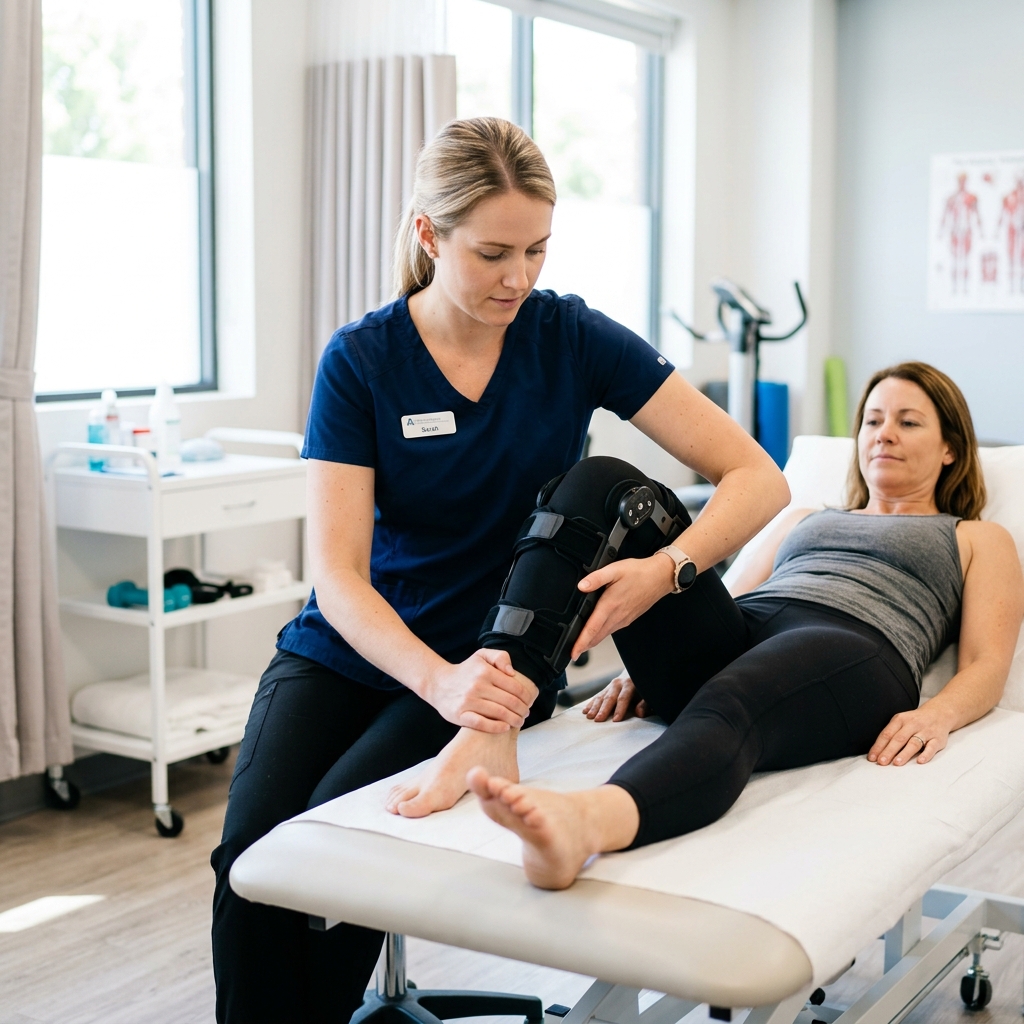
A sharp pinch inside your knee when twisting, difficulty straightening your leg fully, or local swelling after walking are classic signs of a **meniscus tear**. The meniscus is a C-shaped piece of tough, rubbery cartilage that acts as a vital shock absorber between your thighbone (femur) and shinbone (tibia).
When a meniscus is torn—often due to sudden twisting in sports or gradual age-related wear (degenerative tears)—it can restrict knee movement and cause sharp pain. However, a meniscus tear does not automatically mean you need surgery.
At **Physio Dynamics** in Panamaram, Wayanad, lead physiotherapist **Dr. Sandra Thomas (PT)** utilizes targeted, low-impact muscle loading and joint mobility protocols to treat meniscus tears non-surgically and restore full joint stability.
Important Note: If your knee is completely locked (you cannot straighten it at all) or frequently "gives way" under you, consult an orthopedic specialist immediately. These symptoms indicate a displaced tear that may require surgical evaluation.
The "Red Zone" vs. "White Zone"
Whether a meniscus tear can heal without surgery depends heavily on its location:
- The Red Zone (Outer 1/3): This area has a rich blood supply. Tears in this zone have excellent healing potential and respond exceptionally well to conservative physiotherapy.
- The White Zone (Inner 2/3): This area lacks blood flow. Tears here cannot biologically heal on their own, but progressive physical therapy can make them completely pain-free by strengthening surrounding muscles to absorb shock.
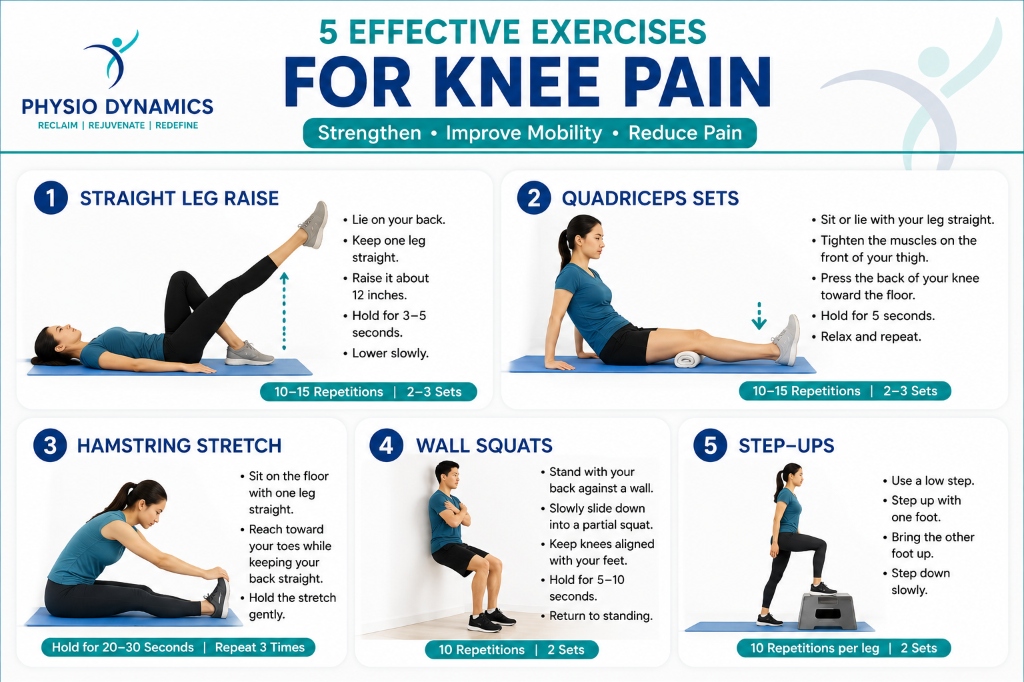
Knee Stabilization Exercises recommended by Physio Dynamics, Panamaram, Wayanad
4 Key Exercises for Meniscus Recovery
Straight Leg Raise (SLR)
Building quadriceps strength is critical to support the knee joint, but bending the knee under load compresses the meniscus. The SLR builds quad strength with zero joint compression.
How to Perform
- Lie on your back with your uninjured knee bent and foot flat.
- Lock your injured knee completely straight.
- Slowly lift the leg about 12 inches (30 cm) off the ground.
- Hold for 3 seconds, then lower slowly.
Standing Hamstring Curls
Hamstrings control knee deceleration and stability. Curls strengthen the back of the leg safely without placing shear weight on the knee.
How to Perform
- Stand upright holding a chair or wall for balance.
- Slowly bend your injured knee, lifting your heel up toward your buttocks.
- Hold the bent position for 2 seconds.
- Slowly lower the foot back to the floor.
Sidelying Clamshells
Weak hip stabilizers (gluteus medius) cause the knee to collapse inward during walking, pinching the meniscus. Clamshells build glute strength to keep the knee aligned.
How to Perform
- Lie on your side with hips stacked and knees bent at 90 degrees. Keep feet together.
- Keep your heels touching and slowly raise your top knee as high as comfortable without rotating your pelvis.
- Hold for 2 seconds, then slowly lower.
Terminal Knee Extension (TKE)
TKE targets the vastus medialis oblique (VMO) muscle, which stabilizes the kneecap and controls joint terminal extension during walking.
How to Perform
- Loop a resistance band around a secure post and place it behind your injured knee.
- Stand facing the anchor point with the knee slightly bent.
- Push your knee backward against the band's resistance to straighten the leg fully.
- Squeeze your thigh muscle for 3 seconds, then slowly return to starting position.
Movements to Avoid
To prevent aggravating the tear, avoid the following high-risk movements during recovery:
- Pivoting and Twisting: Swiveling on the foot of the injured leg puts high shear stress on the meniscus.
- Deep Squats (past 90°): Compresses the posterior horn of the meniscus, causing sharp pain.
- Running on Hard Surfaces: High-impact forces irritate the inflamed joint.
How Physiotherapy Offloads the Meniscus
At **Physio Dynamics** (Panamaram, Wayanad), our treatment is focused on reducing knee load. We provide:
Frequently Asked Questions
Protect Your Knee Cartilage
If knee clicking, pinching, or pain is limiting your movements, let our expert sports physiotherapists help you recover safely.