
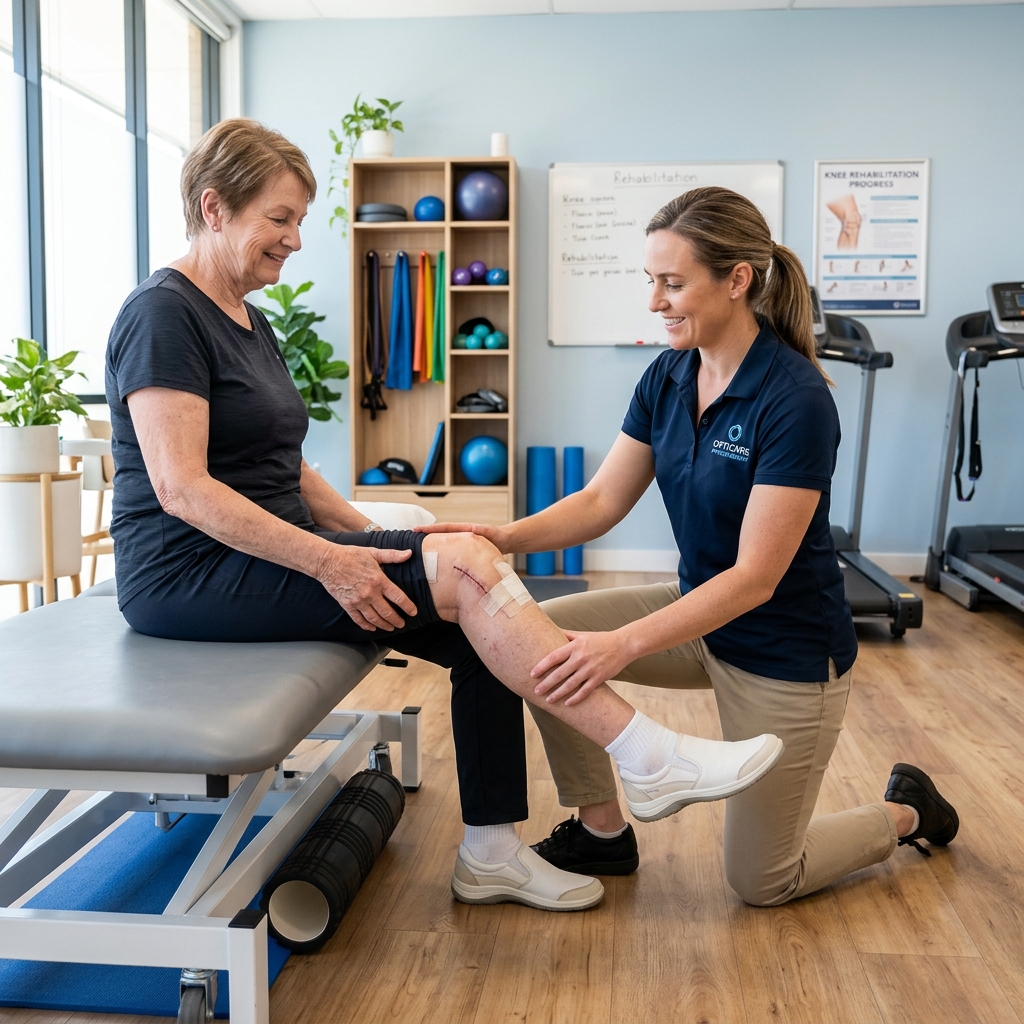
Total Knee Replacement (TKR), also known as total knee arthroplasty, is one of the most successful surgical procedures for individuals suffering from severe knee osteoarthritis, chronic pain, or joint degeneration. However, an essential truth every orthopedic surgeon will emphasize is that surgery is only 50% of the battle. The remaining 50% depends on structured, evidence-based post-surgery physiotherapy rehabilitation.
Without immediate and guided physical therapy, scar tissue can form rapidly around the newly implanted joint capsule, leading to stiffness, persistent limp, and restricted joint movement.
At Physio Dynamics in Panamaram, Wayanad, lead physiotherapist Sandra Thomas, BPT, guides knee replacement patients through structured recovery phases to ensure optimal range of motion, muscle strength, gait correction, and functional freedom.
Medical Disclaimer: Every surgical procedure and patient recovery profile is unique. Always follow the specific protocols provided by your orthopedic surgeon and physical therapist. Never push through sharp, intense joint pain without medical guidance.
Post-Knee Replacement Rehabilitation Timeline & Milestones
A successful knee replacement rehabilitation is divided into 4 key recovery phases. Each phase targets specific clinical milestones to protect the surgical implant while progressively building joint function.
Phase 1: Days 1 to 7 (Immediate Post-Op & Hospital Stay)
Focus: Pain and swelling control, Deep Vein Thrombosis (DVT) prevention, early mobility, and achieving 0° to 60° knee flexion.
- Circulation Exercises: Ankle pumps and toe wriggles to encourage venous blood flow and prevent blood clots.
- Early Quadriceps Activation: Gentle quad sets to prevent muscle shut-down (arthrogenic muscle inhibition).
- Straight Leg Extension: Keeping a towel roll under the ankle while resting to enforce full 0° knee extension.
- Assisted Ambulation: Standing and walking short distances with a walker or bilateral crutches under physiotherapist supervision.
Phase 2: Weeks 2 to 6 (Early Outpatient & Range of Motion Focus)
Focus: Achieving 90°+ knee bending (flexion), full active knee straightening (extension), scar mobilization, and transitioning off walking aids.
- Range of Motion (ROM): Heel slides, seated knee flexions, and gentle patellar (kneecap) glides to prevent adhesions.
- Transitioning Walking Aids: Progressing from a walker to a single cane, correcting any antalgic (limping) gait patterns.
- Stationary Cycling: Initiating gentle back-and-forth rocking on a stationary bike, progressing to full pedal rotations.
- Wound & Scar Care: Gentle soft tissue massage once surgical incisions have fully closed.
Phase 3: Weeks 7 to 12 (Strengthening & Stair Mobility)
Focus: Achieving 110°–120° knee flexion, building leg endurance, stair climbing, and returning to routine daily activities.
- Progressive Resistance Exercises: Wall squats (0°-45°), step-ups, step-downs, and hamstring curls.
- Stair Training: Learning the golden rule — "Up with the good, down with the bad" (leading with the non-operated leg going up stairs, leading with operated leg going down).
- Balance & Proprioception: Single-leg stance drills and weight-shifting exercises to improve joint stability.
Phase 4: Months 3 to 6+ (Advanced Function & Long-Term Health)
Focus: Full functional independence, brisk walking, swimming, light sports, and joint protection for long-term implant longevity.
- Restoration of full muscular symmetry between legs.
- Returning to low-impact recreational activities (gardening, brisk walking, light trekking, swimming).
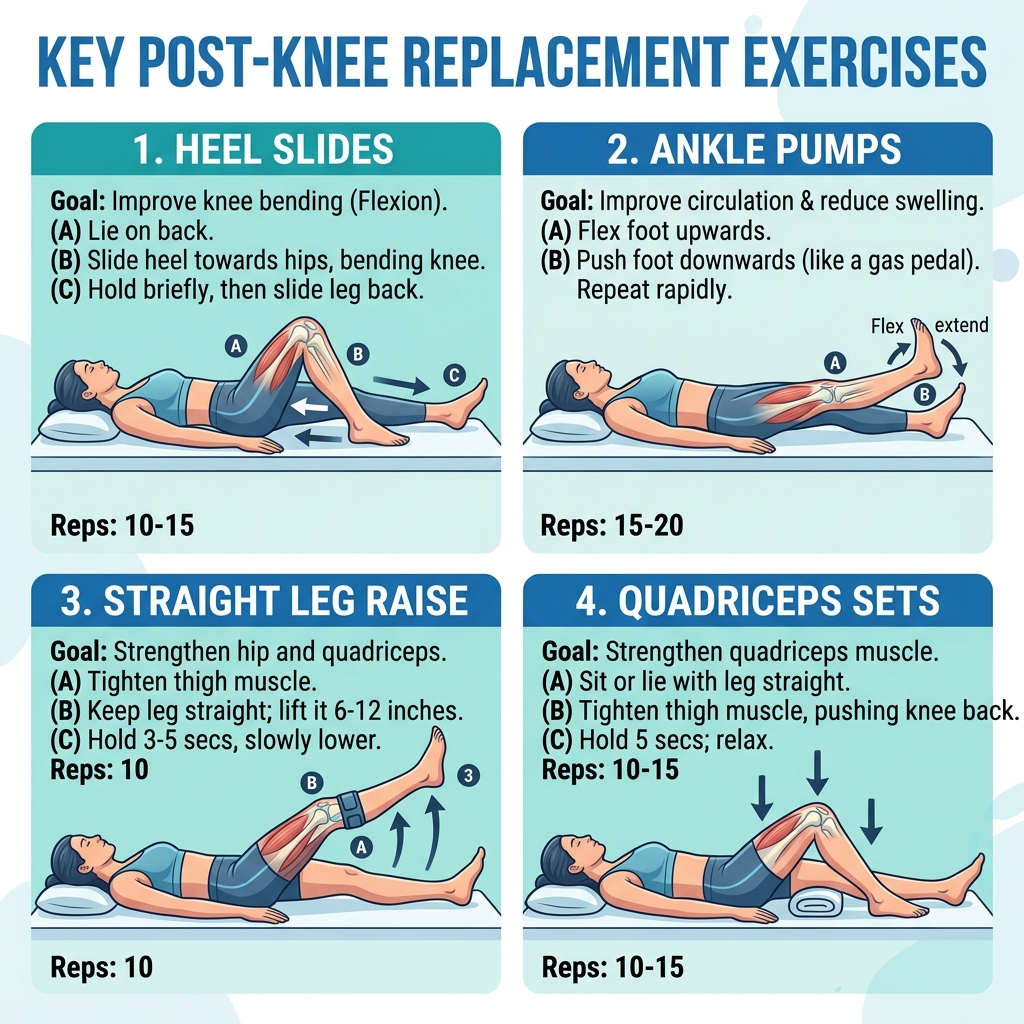
Essential Post-Knee Replacement Exercises recommended by Physio Dynamics, Panamaram, Wayanad
Top 5 Rehabilitation Exercises After Knee Surgery
Heel Slides (Knee Flexion)
Heel slides are the gold-standard exercise for gradually restoring knee bending (flexion) after surgery without straining the joint capsule.
How to Perform
- Lie on your back on a firm bed or exercise mat.
- Slowly slide your heel toward your buttocks, allowing your knee to bend as far as tolerable.
- Hold the bent position for 5 seconds at the point of gentle stretch.
- Slowly slide your heel back down until the leg is completely flat.
Ankle Pumps & Rotations
Ankle pumps promote blood flow in the calf muscles, acting as a muscular pump to prevent DVT (blood clots) and reduce lower leg swelling.
How to Perform
- Lie or sit comfortably with your leg extended.
- Point your toes away from you (like pressing a pedal), then pull your toes back toward your nose.
- Move fluidly and continuously through full ankle range.
- Follow with gentle clockwise and counter-clockwise ankle circles.
Quadriceps Sets (Quad Lock)
Re-activating the quadriceps muscle group is crucial immediately after knee surgery to prevent thigh muscle atrophy and regain knee control.
How to Perform
- Lie flat on your back with your leg straight.
- Tighten the muscle on top of your thigh by pressing the back of your knee firmly into the bed.
- Ensure your kneecap glides slightly upward toward your hip.
- Hold the contraction tightly for 5 seconds, then relax completely.
Straight Leg Raise (SLR)
Straight Leg Raises strengthen both the hip flexors and quadriceps, building the strength required to lift your leg in and out of bed or a car.
How to Perform
- Lie flat on your back. Bend your non-operated knee with foot flat on the bed.
- Tighten the quadriceps of your operated leg so the knee is locked 100% straight.
- Slowly lift the straight leg about 6 to 12 inches (15–30 cm) off the bed.
- Hold for 3 to 5 seconds, then lower the leg smoothly under control.
Terminal Knee Extension (TKE)
Terminal Knee Extension targets the VMO (Vastus Medialis Oblique) muscle, essential for locking out the knee when standing and walking.
How to Perform
- Sit on a firm chair or edge of the bed with knees bent at 90 degrees.
- Slowly raise the lower leg of your operated side until the knee is fully straight.
- Squeeze the inner thigh muscle at full extension and hold for 5 seconds.
- Lower the foot slowly back to the starting position.
Crucial Post-Surgery Do's and Don'ts
DO's
- Place a towel roll under your ankle when resting in bed to gravity-assist full knee extension.
- Apply ice packs for 15–20 minutes after exercise to control post-workout swelling.
- Perform exercises consistently as prescribed by your physiotherapist.
- Wear non-skid footwear during all walking sessions to prevent accidental slips.
DON'Ts
- DON'T place a pillow directly under your knee while resting — this causes a permanent knee bending contracture!
- DON'T twist or pivot abruptly on your operated leg.
- DON'T skip pain medication before therapy if advised by your doctor — managing pain enables better exercise tolerance.
- DON'T sit in low, soft chairs that make standing difficult.
Expert Post-Surgical Physiotherapy in Wayanad
Recovering from a total knee replacement requires precise clinical guidance, objective progress tracking, and compassionate support. At Physio Dynamics (Panamaram, Wayanad), our post-surgical rehabilitation service includes:
For patients unable to travel to our clinic during early post-operative weeks, our team offers Home Care Physiotherapy services covering Panamaram, Mananthavady, Kalpetta, and nearby areas across Wayanad.
Frequently Asked Questions
Recover Faster with Expert Post-Surgery Physiotherapy
Schedule an in-clinic consultation or home care visit in Wayanad with Dr. Sandra Thomas (PT) to start your personalized knee recovery plan.