
After 4 to 8 long weeks of wearing a heavy plaster cast or protective surgical splint, having your orthopedic doctor announce that your bone fracture is officially united brings immense emotional relief. However, the moment the cast is cut open, many patients across Wayanad experience an unexpected shock: the newly freed joint feels rigid as a board, pale, weak, slightly swollen, and painful to move even a single centimeter.
Whether you suffered a distal radius wrist fracture, an ankle malleolar fracture, an elbow epicondylar break, or a knee tibial plateau injury, post-fracture joint stiffness is extremely common. The good news is that with methodical, evidence-based physical rehabilitation, joint flexibility, tissue elasticity, and full muscular strength can be completely restored.
Understanding the Physiology: Why Does Post-Fracture Stiffness Happen?
To safely treat joint stiffness, it helps to understand what happened inside your body while the bone was healing under complete immobilization:
- Capsular Tightness & Collagen Cross-Linking: Joint capsules and surrounding ligaments are made of collagen fibers. During weeks of non-movement, synovial fluid secretion drops, causing collagen fibers to form random, tight cross-links (micro-adhesions). This shrinks the joint cavity and restricts normal gliding movements.
- Arthrogenic Muscle Inhibition (AMI) & Disuse Atrophy: Immobilization causes rapid muscular wasting (atrophy), particularly in stabilizing slow-twitch (Type I) muscle fibers. Furthermore, neurological inhibition prevents the brain from firing the muscles surrounding the previously injured bone.
- Persistent Edema & Lymphatic Stagnation: Without regular muscle contraction to act as a natural venous pump, fluid accumulates around the joint. If left unmanaged, chronic swelling organizes into dense fibrinous scar tissue.
- Tendon Shortening & Fascial Tightness: Tendons that cross the immobilized joint lose their natural elasticity, making stretching or bending feel tight and resistive.
The 4-Phase Post-Fracture Rehabilitation Timeline
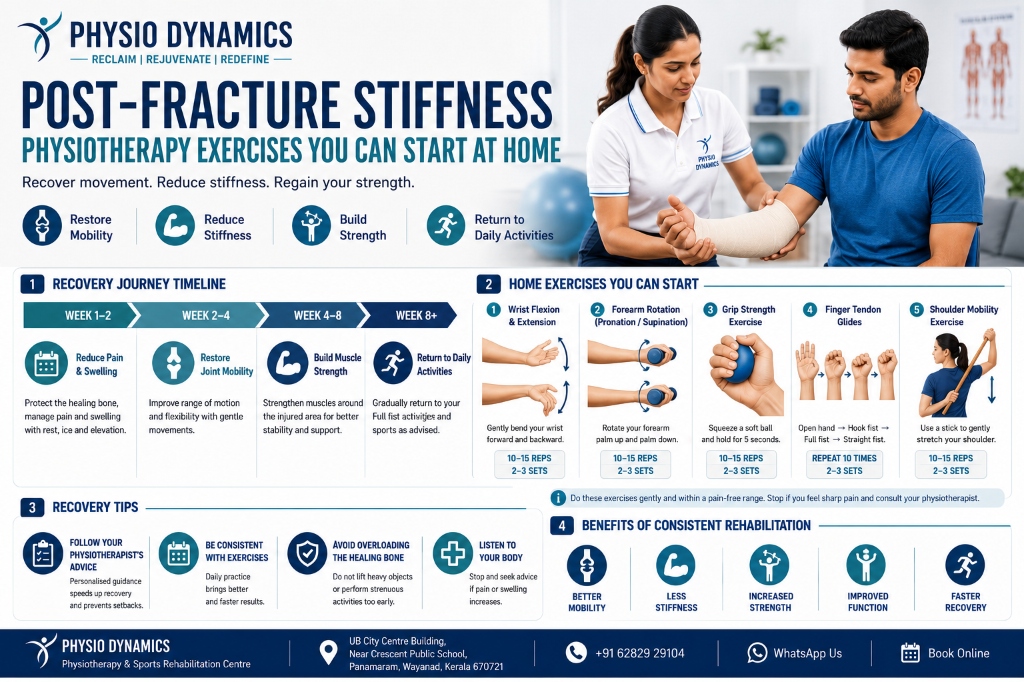
Rehab after a bone fracture is not a single aggressive stretch—it is a progressive timeline engineered around bone callus maturation and soft tissue remodelling:
Post-Cast Recovery Journey:
- Phase 1 (Week 1–2): Protection & Pain Management — Focus on swelling reduction with moist heat, gentle elevation, skin hygiene, and sub-maximal isometric contractions. Protect the fragile healing bone while initiating active-assisted movement.
- Phase 2 (Week 2–4): Restoring Joint Mobility & ROM — Active-assisted range of motion glides, capsular stretching, gentle soft tissue mobilization, and active finger/wrist/ankle range glides.
- Phase 3 (Week 4–8): Building Muscle Strength & Endurance — Progressive loading with resistance bands, light dumbbells, grip trainers, and closed kinetic chain weight-bearing exercises as permitted by your orthopedist.
- Phase 4 (Week 8+): Functional Re-education & Return to Daily Life — Proprioception balance training, agility drills, sports-specific movements, and full heavy manual work clearance.
Safe Home Exercises You Can Start Immediately
Crucial Safety Note: Always confirm with your orthopedic surgeon or physiotherapist that your bone callus shows radiological union before starting active exercise. Work strictly within a comfortable, pain-free range.
1. Warm Water & Thermal Preparation (10-15 Minutes)
Before attempting any movement, soak your stiff wrist, hand, or foot in warm water (38°C–40°C) or apply a warm moist towel over the joint for 10–15 minutes. Heat increases tissue temperature, improves collagen extensibility by up to 300%, and lowers synovial fluid viscosity, making subsequent stretching significantly smoother and less painful.
2. Wrist Flexion & Extension Glides (Upper Extremity)
Rest your forearm comfortably on a table with your hand hanging slightly over the edge:
- Gently bend your wrist downward towards the floor (flexion) until you feel a firm, mild stretch. Hold for 3–5 seconds.
- Slowly lift your wrist upward towards the ceiling (extension). Hold for 3–5 seconds.
- Repetitions: 10–15 reps, 2–3 sets daily.
3. Forearm Pronation & Supination (Rotation)
Keep your elbow bent at a 90-degree angle tucked against your side:
- Slowly rotate your forearm so your palm faces up towards the sky (supination). Hold for 5 seconds.
- Rotate your forearm in the opposite direction until your palm faces the floor (pronation). Hold for 5 seconds.
- Tip: You can hold a small lightweight object (like a water bottle or light dumbbell) to provide gentle rotational momentum.
- Repetitions: 10–15 reps, 2–3 sets daily.
4. Finger Tendon Glides & Grip Strength Exercises
For wrist or forearm fractures (such as Colles or Smith fractures), finger stiffness is extremely common. Perform the 4-stage tendon glide sequence:
- Open Hand: Extend all fingers straight out.
- Hook Fist: Bend your finger tips down to touch the top palm pads while keeping main knuckle joints straight.
- Full Fist: Squeeze into a tight full fist.
- Straight Fist: Bend at knuckles keeping fingers straight.
- Squeeze Exercise: Hold a soft foam rehabilitation ball or stress ball in your palm, squeeze firmly for 5 seconds, and release slowly.
- Repetitions: 10 repetitions of glides; 10–15 ball squeezes, 2–3 sets daily.
5. Shoulder & Wand Mobility Exercises
If your fracture involved the upper arm, collarbone, or shoulder, or if prolonged arm sling usage tightened your shoulder joint:
- Grasp a light wooden stick or wand with both hands in front of you.
- Use your uninjured arm to assist and gently push the wand upward overhead or sideways to stretch the affected shoulder into flexion and abduction.
- Repetitions: 10–15 smooth repetitions, 2–3 sets daily.
Important Precautions & Red Flag Warning Signs
While mild stretch discomfort and muscle fatigue are expected during rehabilitation, you must never force a joint through sharp, stabbing pain. Stop immediately and contact your physiotherapist if you observe:
- Sudden sharp, localized bone pain over the original fracture site.
- Excessive swelling, redness, or heat around the joint that persists overnight.
- Numbness, tingling, or skin color changes (pale or bluish tinge) in your fingers or toes.
- Signs of Complex Regional Pain Syndrome (CRPS)—extreme burning pain disproportionate to touch, hypersensitivity, or unusual sweating.
When & Why You Need Clinical Physiotherapy
Home exercises provide a solid foundation for early mobility, but chronic capsular tightness and severe muscle inhibition usually require specialized clinical intervention. At Physio Dynamics in Panamaram, Wayanad, Dr. Sandra Thomas (PT) provides comprehensive post-fracture orthopedic rehabilitation tailored to your specific injury type:
- Manual Joint Mobilizations (Maitland & Mulligan Techniques): Skilled passive accessory glides applied directly to joint surfaces to release stubborn capsular adhesions without stressing the healing bone.
- Electrotherapy & Ultrasound Therapy: Targeted high-frequency ultrasound soundwaves to break down deep scar tissue and improve local tissue vascularity.
- Instrument-Assisted Soft Tissue Mobilization (IASTM): Specialized ergonomic tools used to release tight fascial restrictions along immobilized tendons.
- Progressive Strength & Neuromuscular Retraining: Advanced isometric, isotonic, and functional resistance protocols designed to restore full muscular symmetry and joint stability.
Post-Fracture Rehabilitation in Wayanad
Recovering from a bone fracture or cast removal? Book a personalized rehabilitation assessment with Dr. Sandra Thomas at Physio Dynamics, Panamaram.
Frequently Asked Questions
Common questions about post-fracture rehabilitation and stiffness management