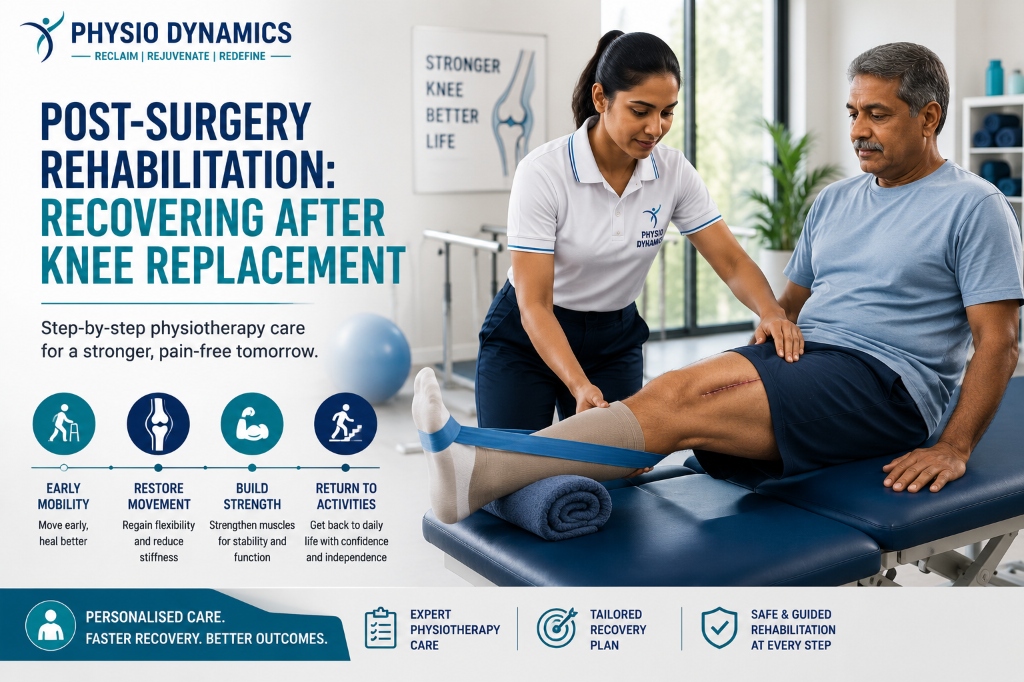
Total knee replacement (TKR) surgery can relieve severe joint pain and restore lost mobility — but the operation itself is only 50% of the equation. Targeted post-operative physiotherapy is what truly dictates how smoothly your artificial joint moves, how much thigh strength you regain, and how fast you return to an active, independent life.
At Physio Dynamics in Panamaram, Wayanad, Chief Physiotherapist Dr. Sandra Thomas provides specialized post-surgical rehabilitation tailored to every stage of knee replacement recovery.
Clinical Safety Warning: Always perform post-surgical exercises under the direct guidance of your orthopedic surgeon and registered physiotherapist. Seek immediate medical attention if you experience severe calf swelling/warmth, sudden shortness of breath, fever above 100°F, or surgical wound drainage.
Why Physiotherapy Is Essential After Knee Replacement
While an orthopedic surgeon installs the titanium and polyethylene joint implants, the surrounding soft tissues — including quadriceps, hamstrings, joint capsule, and ligaments — require methodical retraining. Without structured physical therapy, patients face permanent joint stiffness, muscle inhibition (quadriceps lag), and abnormal limping gait patterns.
Key Goals of Post-Knee Replacement Rehabilitation
A structured physical therapy program targets six main functional milestones:
The 4-Stage Knee Replacement Recovery Protocol
Rehabilitation progresses systematically through four distinct recovery phases:
Stage 1: Days 1–7 (Hospital & Early Home Recovery)
The primary goal during week one is managing surgical swelling while gently initiating joint gliding and preventing blood clots (DVT).
Recommended Interventions & Exercises:
- Ankle Pumps: Flex and extend your feet 10–15 times every hour to promote venous circulation.
- Isometric Quadriceps Sets: Press the back of your knee firmly into the bed and hold for 5 seconds to activate sleeping quad muscles.
- Gentle Heel Slides: Slowly slide your heel toward your buttocks, aiming for 60° to 70° knee bending without forcing.
- Safe Transfers & Early Weight-Bearing: Practise standing up from a chair and walking with a walking frame or crutches with guidance.
- Cryotherapy & Elevation: Apply ice packs for 20 minutes with the leg elevated above heart level 4 times daily.
Stage 2: Weeks 2–6 (Building Range of Motion & Muscle Activation)
During weeks 2 to 6, inflammatory swelling diminishes and rehabilitation focuses on aggressive range of motion gains and unassisted walking.
Recommended Interventions & Exercises:
- Seated Knee Flexion & Extension: Sit on a high chair and gently use your non-operated leg to push the operated knee into deeper flexion (aiming for 90° to 100°).
- Straight Leg Raises (SLR): Lift the straight leg 30 cm off the floor without letting the knee bend (eliminating quad lag).
- Stationary Bicycle Ergometry: Begin half-revolutions on a stationary exercise bike, gradually achieving smooth 360° rotations.
- Progressive Gait Retraining: Wean off walking frames or crutches to a single walking stick, and eventually walk unassisted with an even stride length.
Stage 3: Weeks 6–12 (Functional Strength, Balance & Stairs)
By week 6, most surgical incisions are fully healed. Rehabilitation transitions into closed-chain strength and functional balance training.
Recommended Interventions & Exercises:
- Mini Wall Squats: Perform partial squats against a wall (0° to 45° knee bend) to strengthen quadriceps and glutes.
- Step-Up & Step-Down Exercises: Practice stepping up onto a 15 cm step with the operated leg, leading into reciprocal stair climbing.
- Single-Leg Balance Training: Stand on the operated leg on a stable surface for 20–30 seconds to rebuild joint proprioception.
- Resistance Band Workouts: Incorporate light elastic bands for hamstring curls and hip abduction exercises.
Stage 4: Months 3–6+ (Long-Term Strength & Active Life)
The final phase solidifies muscular symmetry and prepares the joint for high-end daily activities, travel, and low-impact sports.
Recommended Interventions & Exercises:
- Advanced Lower-Limb Conditioning: Leg press machines, lunges, and endurance walking on varied terrain in Wayanad.
- Low-Impact Aerobics: Swimming (freestyle/backstroke), outdoor cycling, and brisk walking.
- Long-Term Joint Protection Strategy: Education on avoiding high-impact activities (jogging, heavy jumping) to protect joint prosthesis longevity for 20+ years.
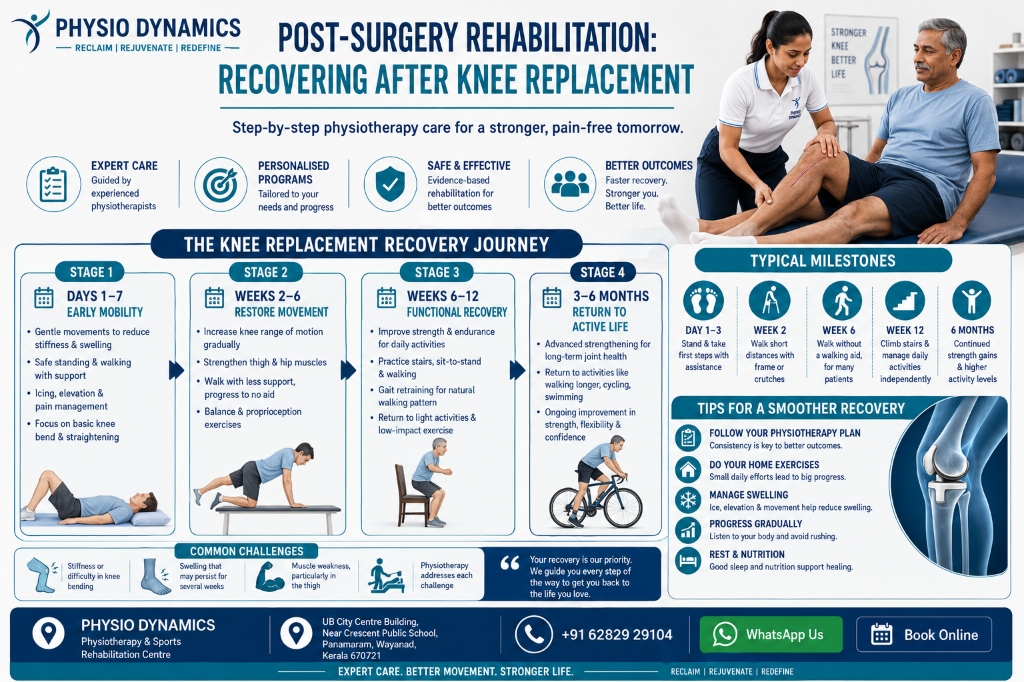
Step-by-Step Total Knee Replacement Recovery Timeline & Milestones by Physio Dynamics, Panamaram, Wayanad
Total Knee Replacement Milestones Table
Tracking progress against standard clinical timelines helps ensure recovery remains on target:
| Recovery Period | Knee Range of Motion (ROM) | Mobility & Function Milestone |
|---|---|---|
| Days 1–3 | 0° to 60° Flexion | Standing and taking short steps with a walking frame |
| Week 2 | 0° to 80° Flexion | Walking short distances; managing basic home transfers |
| Week 6 | 0° to 100° Flexion | Walking unassisted; driving (if right leg cleared by surgeon) |
| Week 12 | 0° to 110°–120° Flexion | Navigating stairs reciprocally; returning to light work |
| Months 6–12 | Full Functional ROM | Long-distance walking, swimming, cycling, and travel |
Note: Every patient recovers at a unique pace depending on pre-surgery deformity, age, and individual tissue healing. Your physiotherapist will customize these milestones for you.
Overcoming Common Post-Surgical Challenges
Common Recovery Roadblocks We Treat:
- Persistent Joint Stiffness: Addressed through specialized Maitland & Mulligan manual joint mobilizations.
- Quadriceps Lag (Inability to lift straight leg): Treated with Neuromuscular Electrical Stimulation (NMES) and biofeedback.
- Ongoing Swelling & Pain: Managed using targeted lymphatic drainage, compression, and cold therapy.
- Fear of Weight-Bearing: Overcome through progressive gait re-education and balance confidence building.
Post-Knee Replacement Care at Physio Dynamics
At Physio Dynamics in Panamaram, Wayanad, we deliver evidence-based, compassionate post-operative care tailored to your surgeon's specific guidelines:
- 1-on-1 private clinical sessions with lead physiotherapist Dr. Sandra Thomas (HCPC UK Registered)
- Specialized orthopedic physiotherapy rehabilitation
- Home visit physiotherapy care across Wayanad for patients unable to travel early in recovery
- Hands-on manual therapy for scar tissue breakdown and joint mobilization
- Customized exercise sheets and continuous recovery monitoring
Frequently Asked Questions
Book Post-Knee Replacement Rehabilitation in Wayanad
Recovering from knee replacement surgery? Let Dr. Sandra Thomas guide your step-by-step recovery for optimal joint mobility and strength.

Dr. Sandra Thomas, BPT
Dr. Sandra Thomas is a Bachelor of Physiotherapy (BPT) graduate and an HCPC (UK) Registered Physiotherapist with extensive clinical experience in orthopaedic, sports, and neurological rehabilitation. She founded Physio Dynamics in Panamaram, Wayanad in August 2024 with a vision to bring expert, evidence-based physiotherapy care to the community of Wayanad.